We are continuing our special offer – if you buy three books or more and live in the normal European Union zone (as defined by UPS – for example, they exclude some islands and remote areas) we will send you an extra book free. The previous default option on the free book was The Alterman Gambit Guide – White Gambits.
As mentioned last month, for November we will switch the default option to THE ALTERMAN GAMBIT GUIDE -BLACK GAMBITS VOLUME 1 (and it will be VOLUME 2 for December). But if you already have the Alterman Gambit Guide book, or would prefer a different free book, then send us an email to salesgroup@qualitychess.co.uk with your order, asking to have it replaced with one of the following titles:
QUALITY CHESS PUZZLE BOOK
CHESS LESSONS
CARLSEN’S ASSAULT ON THE THRONE
POSITIONAL CHESS SACRIFICES
GRANDMASTER VERSUS AMATEUR
GRANDMASTER BATTLE MANUAL
REGGIO EMILIA 2007/2008
TACTIMANIA
SAN LUIS 2005
ATTACKING THE SPANISH
CUTTING EDGE 1: THE OPEN SICILIAN
CUTTING EDGE 2: SICILIAN NAJDORF 6.Be3
This week’s poll question is effectively replaced by the World Championship Quiz, but I should mention the result of last week’s poll. Read more…
Hi guys! We thought we would try this. A vlog, video blog post, that is. The sound is not great, to say the least, but clear enough I hope. Sorry, we are trying. It is a bit too long. Sorry again. Mainly we are experimenting with the technology and trying to make it work. Give us a chance and we promise that we will get it better and better with time.
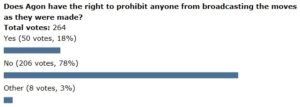
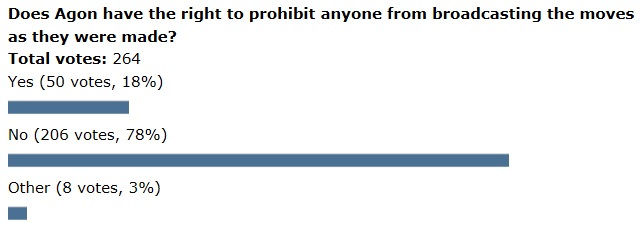
Last week’s question was “Does Agon have the right to prohibit anyone from broadcasting the moves as they were made?” We saw a strong vote in favour of ‘No’. The courts (firstly in Moscow) will give their more binding verdicts in due course. Agon are trying to change the way chess broadcasts have been done in recent years, and I believe our vote does illustrate that resistance to that change is likely, for a start from chess fans.
This week I will stay with the World Championship in New York, but move on to the board and some real chess moves. We have over two weeks to go, so I will save score predictions for next week, but for now I want to guess/predict the openings that will feature in the match.
As a starting point, consider what the players have played in recent years (let’s say 2013-2016). Both can play any of the ‘Big Four’ first moves (1.e4, 1.d4, 1.Nf3 and 1.c4) but I would say Karjakin is a 1.e4 player who often switches to 1.Nf3, while Carlsen plays 1.e4 and 1.d4 about equally. Let’s see that in pictures…
Read more…
Anton Visser – Anthony Waller
Correspondence, 2015-16
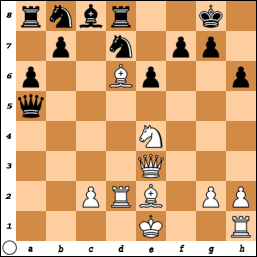
We always enjoy hearing success stories from our readers. One such message came in last week from Anton Visser, who tested Parimarjan Negi’s repertoire against the Najdorf in a correspondence game. Anton’s verdict on Negi’s analysis is that it was “better than the computer my opponent used.” Here is the game:
1.e4 c5 2.Nf3 d6 3.d4 cxd4 4.Nxd4 Nf6 5.Nc3 a6 6.Bg5 e6 7.f4 Qb6 8.Qd2 Qxb2 9.Rb1 Qa3 10.e5 dxe5 11.fxe5 Nfd7 12.Ne4 h6 13.Bh4 Qxa2 14.Rd1 Qd5 15.Qe3 Qxe5 16.Be2 Bc5 17.Bg3 Bxd4 18.Rxd4 Qa5+ 19.Rd2 0–0 20.Bd6 Rd8
We are deep into one of the crazy main lines of the Poisoned Pawn. Parimarjan (or “Pari”, as we call him) analyses it in Chapter 15 of 1.e4 vs the Sicilian I.
Read more…
Last week’s question was “How does a 2500 player now compare with a 2500 player 20 years ago?” The most common view was that the 2500 player in 2016 is weaker than the 2500 player in 1996. But as the discussion showed, it’s not a simple topic, as measuring or even defining inflation in chess ratings is not easy.

The World Championship match is approaching – Magnus Carlsen will defend his title against Sergey Karjakin in New York from November 11-30. In the weeks to come I expect we will debate and predict what will happen over the board, but a first question is: from where will you watch the match? If you are able to get to New York and have a ringside seat, then lucky you. But I suspect most will be watching on some website. Which brings me to Agon, “the company that owns the commercials rights to organize the World Championship” and their new broadcast policy.
You can read all about it at the link, but my short version goes like this:
Read more…
Bogged down by work, we never got around to sharing pictures of the happy winners of the Olympiad Quiz and their winnings. Here they are, Piotr and Ferdo.
Read more…
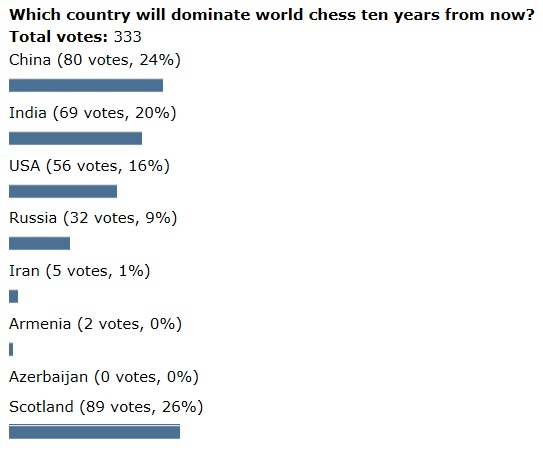
Last week’s question was: ‘Which country will dominate world chess ten years from now?’ And the answer is… Scotland?! Ignoring all those super-patriots and jokers, I will rule out a tartan charge to greatness, and view the true order as China, India, USA, Russia. Intriguing to see Russia so low in your rankings. Maybe the Russian conveyor belt of elite chess talent is slowing, if not quite grinding to a halt?

This week I am interested in FIDE ratings, inflation (or deflation?) and whether today is a golden era for elite chess. If you look at the Live Chess Ratings site, you will see four players rated over 2800, with Magnus Carlsen naturally first, on 2853. I believe Bobby Fischer peaked at 2785.
Even if you believe there has been inflation in the system (as I think most do) it’s still possible that today’s batch of top players represent a golden era of chess. Just one example: Pavel Eljanov’s recent brilliance at the Baku Olympiad and especially the Chess.com Isle of Man International have jumped him up to Number 16 in the world. Eljanov is a wonderful player, but the rating system says there are 15 even better. Has there ever before been such strength in depth in world chess?
There are many ways to frame a poll question to debate playing strength versus inflation. One option was “How many players will be rated over 2800 three years from now?” But I will go with another Jacob suggestion: “How does a 2500 player now compare with a 2500 player 20 years ago?” Stronger or weaker or about the same?
Obviously we have just published King’s Indian Warfare and Grandmaster Repertoire 19 – Beating Minor Openings. We are very pleased with both of these.
But a number of you have asked for a peek behind the curtain, to see what we are working on besides these. I do not have dates to give you, but I will give you a quick rundown of the general direction of things.
The first books coming out will be something like Luther’s Chess Reformation, which is essentially done and Richard Pert on the Ragozin for Black (starting on move 3, I think). Also Michael Roiz on the Nimzo-Indian is close to completion, as is Key Concepts of Gambit Play by Razuvaev. All four books could make it out in 2016, but it could be close. The reason is that printing and distribution time is usually four weeks, but with Christmas coming, things slow down as we fight for a slot in at the printer with Swedish and Finnish Christmas catalogues. Add a few weeks for finishing the editing and proof reading and it is a bit tight. But there is very reasonable hope.
A bit further down the line we will have the final volume on the King’s Indian by Kotronias, which he delivered quite recently. It will take serious editing, but is next in line. Also the final book in the Tal trilogy, Mikhail Tal – The Invincible will be on the books for early next year.
Of course we are working hard on Playing 1.e4 – The Sicilian and the French
. It is far advanced, but all analysis are not done, so I do not want to be too definite. But a lot has been done and I hope we will surprise and bring it out quite quickly.
I am also working on Thinking Inside the Box and Chess from Scratch at the moment. I am sure that the latter has no interest to you guys, but to me it is quite interesting work.

Recent Comments