I have felt a need for a while to talk about the Giri – Shankland game. But obviously I do not want to give an inside story. Those are dull anyway, it is always the height of the ceiling or this and that. Because this was not about chess or chess understanding, as anyone who knows anything will know.
I was sitting in the cinema watching THE FAVOURITE with Kallia, telling her Sam had made a draw. Then five minutes later she said he had lost. I did not believe it. How can you lose this position? Sam’s manager, I and any idiot on the Internet was able to see that this was a fortress, whether or not they had read a New In Chess pocketbook or not. But Sam had indeed resigned in the position I had seen.
Of course you should be careful with such sweeping statements…
As the path to c8 suggested by Jan does not work out that well in practice…
I hope this example will be an encouragement to people that even GMs have bad days and that it does not define them. On the next two days, Sam beat Nepomniatchchi and Kramnik and finished the tournament on 50%, winning six rating points. After Kramnik’s retirement, organisers have received statements from the Indian and Israeli Federations, not to have Sam play with Anand or Gelfand in the last round, as losing to Sam can be a career ending experience, as both Judit Polgar and Vladimir Kramnik can testify.
Jacob was on the Perpetual Chess Podcast, released this week. At Quality Chess we have finally gotten around to sponsor the podcast and we strongly encourage everyone else to give a little to continue this great free product. Jacob spoke about a lot of things in the programme, some of which will be opened up for debate here on the blog next week, starting with the “960 circus?!” and the future of chess. When you are interviewed, there is a temptation to hedge your bets and not give any opinions, but this does not make interesting radio and makes little sense to Jacob. So, he said what he was thinking. Others may disagree, but rather than thinking that is a personal issue, we will have a civilised airing of differences here on the blog. Btw. The next Podcast will be on Game Changer, the chess publication of the year, if you are to believe the hype. This will certainly not be one to miss!
We are continuing our free-fourth-book offer – if you buy three books or more and live in the normal European Union zone (as defined by UPS – for example, they exclude some islands and remote areas) we will send you an extra book free.
Please note that if you buy a Special Offer and are in the EU zone, we will add one free book. For example, if a European buys the Special Offer on Tibor Karolyi’s excellent Tal trilogy, then we send the 3 Tal books in hardback, plus one free extra book.
The previous default option on the free book was Grandmaster versus Amateur. For February and March we will switch the default option to REGGIO EMILIA 2007/2008. But if you already have that book, or would prefer a different free book, then send us an email to salesgroup@qualitychess.co.uk with your order, asking to have it replaced with one of the following titles:
ATTACKING THE SPANISH CARLSEN’S ASSAULT ON THE THRONE CHAMPIONS OF THE NEW MILLENNIUM CUTTING EDGE 1: THE OPEN SICILIAN CUTTING EDGE 2: SICILIAN NAJDORF 6.Be3 GRANDMASTER BATTLE MANUAL GRANDMASTER VERSUS AMATEUR POSITIONAL CHESS SACRIFICES THE ALTERMAN GAMBIT GUIDE – WHITE GAMBITS THE ALTERMAN GAMBIT GUIDE – BLACK GAMBITS VOLUME 1 THE ALTERMAN GAMBIT GUIDE – BLACK GAMBITS VOLUME 2 SAN LUIS 2005 TACTIMANIA
We have a book underway that I feel like announcing: a Grandmaster Repertoire on the Leningrad Dutch by Mihail Marin. When will it be published? No idea. As always, that depends on how smoothly the analysis and writing goes. And how wide awake our editors are.
This book will be a complete repertoire for Black starting after 1.d4 f5. In fact, Mihail will also offer some brief thoughts on other first moves such as 1.Nf3 and 1.c4 from a Dutch player’s perspective.
It’s early days to be mentioning this book, but a few readers have commented on this blog about their desire for a Leningrad Dutch book, so it feels right to say: “We agree, and we are working on it.”
IM Sam Collins referred me to this email, because Adhiban said some nice things about the Quality Chess Academy, but I am putting it up here because Adhiban is fantastic and the game is fantastic and if you have half an hour to watch it, you should.
The latest Quality Chess book available in the Chessable format is GM Jacob Aagaard’s Calculation. If you are interested in this book in this format then it is best to act within a week, as it is Chessable tradition to offer the course at a reduced price for the first week.
If you have bought any of our books in Chessable format then I am interested to hear what you think about it. This is only the third book we have put on Chessable (after The Woodpecker Method and Small Steps to Giant Improvement) and so far feedback seems highly favourable.
Boris participated in some of the training at the camp in November. We created a short video based on one of the examples where Boris felt the intended solution was not the ideal one.
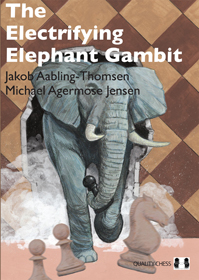
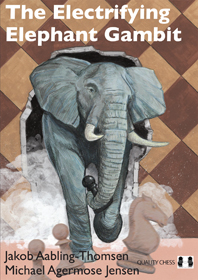
First of all, check out the fantastic cover design for this book!
We have received a number of draft chapters from our Danish friends Michael Agermose Jensen and Jakob Aabling-Thomsen, the Elephant enthusiasts – that is, 1.e4 e5 2.Nf3 d5. They are doing excellent work and I can see the finished book having a ‘Mayhem-in-the-Morra-esque’ effect, whereby people realize the gambit is much better than its reputation.
Having seen snippets of the work, I have not been able to resist experimenting with the Elephant every now and then. I tried it in two rapid games against lower-rated opponents, both of whom accepted the gambit. I went slightly astray in the opening (the relevant chapters have not been delivered yet, so I had to rely on my own guesswork rather than the authors’ expertise) but won both games after some adventures. Perhaps more significantly, I played the Elephant in two local league games against guys in the 2250-2300 range. Both of them were too fearful of the Elephant’s tusks to accept the gambit pawn, and opted for a more timid line involving an early queen exchange. In both cases I equalized quickly and pressed for an advantage, eventually eking out a win in one game and settling for a draw in the other.
Obviously I won’t be playing the Elephant in every game, but so far it has been a delight to get it on the board and force my opponents to think hard at such an early stage. What do our blog readers think? Can you see yourself adding the Elephant to your repertoire as a 6,000 kg surprise weapon?


Recent Comments