On his entertaining blog, IM Sagar Shah gives an in-depth review of Mating the Castled King by Danny Gormally, and discusses how he used the book to help prepare for the recent Indian National Team championships in Goa.

“So is going through this book going to help you to become a better player? Of course! My personal experience is that your mind will start seeing patterns much faster.
When I went to Goa, I setup my chess board on a table in my room. I kept the book of Mating the castled King next to it. Whenever I had some time, I would open a random page and setup a position from the book and solve it. After solving the position, I would just make a note with a tick mark that I had solved the position. Add a star or two next to the problem if I really liked it. In this way, I was solving almost 5-10 positions everyday. This helped me to stay in excellent tactical shape and I was able to remain unbeaten in the tournament. I continued working with the book even after the tournament and I am happy to say that I have completed the 160 positions.
Final words: A unique book which not only helps you to get acquainted with mating patterns against a castled king but also helps you to improve your art of calculation thanks to the excellent quality of analysis.”
The full review is available here.
In The Soviet Chess Primer, by Ilya Maizelis, to be published on 10 December, the chapter on Combination includes a selection of little-known examples from Alekhine. You can test yourself on the following – White to play and win:
Alekhine – Amateur, Groningen (simul) 1933
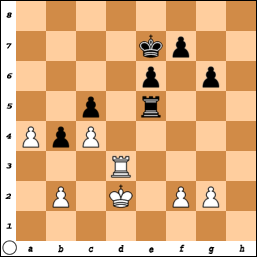
White to move
Read more…
We have not worked out our automated system yet (and it will take a while). So, at the moment we will do it like this:
If you buy three books or more and live inside the European Union (defined by UPS and not by bureaucrats in Brussels!) we will send you a free book.
As a starting point this will be CHAMPIONS OF THE NEW MILLENNIUM.
But if you have it, or would prefer another freebie, please write an email to us with your order, asking to have it replaced with one of following five titles:
SAN LUIS 2005
TACTIMANIA
ATTACKING THE SPANISH
GRANDMASTER VS AMATEUR
REGGIO EMILIA 2007
We will probably run it like this for a while, changing the freebies around a bit.
Jacob was recently interviewed for the Spanish blog Un Andaluz y el Adjedrez. Here is the English version of the interview:

GM Jacob Aagaard
1) Can any person, and I mean ANY, get better at chess studying and competing, in your opinion? Do you think there is a limit, and not everybody is born to be a FM, for instance?
I am sure that there is a limit for some people. There is such a thing as talent for sure, but how important it is, is not really clear. Some minor tests have been done, but the research looking at people over a decade or more has not been done in a way that it can be statistically significant for chess. Not to my knowledge at least.
It has been done in music and the suggestion there was that the early talents did not do that well. The main reason probably being that it was too easy for them in the beginning and they never got into the habit of working hard…
I believe that there is no reason to set barriers to yourself. In principle everyone can learn everything. The question is how long it will take! Is it worth it. And so on.
Read more…
This is a long holiday weekend in Glasgow, the Quality Chess office is closed, and Jacob has gone to the seaside (?), so we have a guest blogger, IM Sagar Shah, with an article taken from his excellent blog:
I have this habit of buying one chess book in every tournament that I play. In this way, my final aim is one day to open a huge library of chess books! And there are some tournaments when I really play well. Then I can use my prize money to buy more chess books.
In my Euro trip which ended just a month ago, I had two huge achievements.
1. I became an International Master (IM) in Spain
2. I won the Dresden Open 2014 and made my maiden GM norm in Germany.
In one of my past articles: People behind my IM title , I had mentioned that there are two chess authors whom I hold in very high regard. One of them is GM Jacob Aagaard and the other is IM Mark Dvoretsky.
When I became an IM in Spain, my wife, Amruta, decided to gift me the latest book written by Aagaard.
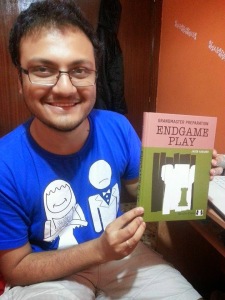
The fifth book from the Grandmaster Preparation series: Endgame play.
The book was pretty expensive. 30 Euros. That comes to nearly Rs.2400. So I had kind of exhausted my resources on book buying for the trip.
Read more…
Here is a list of some of our forthcoming books. As always, the dates are what we are aiming for and not an official publishing schedule.
| Ilya Maizelis |
Chess from Scratch |
October |
| Judit Polgar |
A Game of Queens |
October |
| Tiger Hillarp-Persson |
The Modern Tiger |
October |
| John Shaw |
Playing 1.e4 – Caro-Kann, 1…e5 & Minor Lines |
Winter |
| Boris Gelfand |
Positional Decision Making in Chess |
Winter |
| Mauricio Flores Rios |
Chess Structures – A GM Guide |
Winter |
| Mihail Marin |
Learn from the Legends – Hardback |
Winter |
| Boris Avrukh |
GM Repertoire 1A – 1.d4 The Catalan |
Winter |
| Parimarjan Negi |
GM – 1.e4 vs The Sicilian I |
Winter |
| Emanuel Berg |
GM 16 – The French Defence Vol 3 |
Winter |
| Vassilios Kotronias |
KID – Vol 2 – Mar del Plata I |
Winter |
| Vassilios Kotronias |
KID – Vol 3 – Mar del Plata II |
Winter |
| Lars Schandorff |
GM 20 – Semi-Slav |
Winter |
| Lubomir Ftacnik |
GM 6B – The Najdorf |
Winter |
| Wojciech Moranda |
Race Up the Rankings |
Spring |
| Tibor Karolyi |
Tal’s Best Games 2 – World Champion |
Spring |
| Victor Mikhalevski |
GM 19 – Beating Minor Openings |
Spring |
| Parimarjan Negi |
GM – 1.e4 vs The Sicilian II |
Spring |
| John Shaw |
Playing 1.e4 – Sicilian & French |
Summer |
After the publication of the second opening book I co-authored with Jacob, there is one question that I hear more often again and again: “How can I remember all that theory?” I always thought that this is a serious question, albeit one that has a very simple answer: read and practise!
“Remembering” chess opening theory at a good level is something that means different things for different players. For example, my ambitious 11-year-old student who is preparing to get one of the top 3 places in the Greek youth championships in June has never had a chance until now to reach this position that is part of his preparation with White:
1.e4 e5 2.Nf3 Nc6 3.Bb5 a6 4.Ba4 Nf6 5.0–0 Be7 6.Re1 b5 7.Bb3 0–0 8.h3!
[fen size=”small”]r1bq1rk1/2ppbppp/p1n2n2/1p2p3/4P3/1B3N1P/PPPP1PP1/RNBQR1K1 b – – 0 8[/fen]
So, for him it makes no sense to memorize and try to understand more than 1-2 variations 3-4 moves deep starting from this position. To be honest I am not sure how many players bellow 2200-2300 need to memorize more than that. On the other hand, if you are Anand and have to face Aronian in the first round of the Candidates tournament, then it is essential to remember variations far beyond the known tournament praxis. I suppose that most of the readers of this blog belong to the first category, so the methods and ideas I am going to describe are useful only for them. I am sorry Vishy, maybe I’ll do another blog post later for guys like you!
So, after this first observation,
Read more…
It is now possible to sign up for our newsletter on the Quality Chess website.
This is a quick and easy way to keep up to date with Quality Chess.

Recent Comments