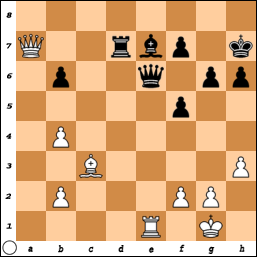
White to play – What is the strongest continuation?
I was visiting Peter Heine Nielsen in around 2009. He was on that day in a bit of a low mood, questioning what he was doing and how he was organising his life. As we all do this from time to time, I do not think I break any confidences in saying this. His biggest frustration was professional. He would spend at least 20 hours each week trying to find an advantage for White against the Marshall and the Berlin Defence (later renamed the Berlin Wall – or very recently, the London Defence by Anand…) on behalf of the then World Champion, Viswanathan Anand. Everyone knew that this was an unachievable task. Still the work had to be done, in order that the advantage would exist only for the brief moment in time that is a game of chess…
A similar thing happens when we are practising calculation. Especially these days when everything is checked by computers. I see it clearly these days while I am working with quite a strong student on his calculation before a series of spring tournaments. He is a very strong player, but calculating is still not an easy task for him.
And the issue with calculation is of course the same as with opening analysis. The game is rigged. Chess is a draw; there is no advantage to be found against good defence. And calculation exercises are an even bigger scam. If you are at your peak, all you can do is match the computer’s findings.
At least theoretically this is so. In reality there are some exercises that are “cooked”, meaning that the student finds something the teacher did not anticipate because of his fallible nature, or (rarely) the computer is beaten by the student. It is very pleasing when it happens in tactical positions; but much more likely to happen in weird cases where calculating 10 moves ahead does not give any significant advantage.
Read more…
A friend of mine had the following position quite recently in a team match:
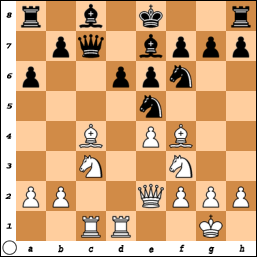
After a long think he played 12.Bb5+, got a worse position and eventually managed to trick his opponent and win. As I walked by the board I saw a simple combination. Is this because I am a great tactician? Probably not. I am the typesetter at Quality Chess and therefore typeset Marc Esserman’s book, Mayhem in the Morra, and probably just recognised the tactic subconsciously.
Read more…
I am sorry that I do not have the time to write a proper blog post today. I have been working till 2am quite a number of nights in a row in order for our books to get sent to the printer before Christmas. Sadly this does not mean early January publication, as they are shut for a few weeks.
The following four books will most likely be released on the 4th of February:
Negi: 1.e4 vs. the Sicilian 1 (360 pages)
Flores Rios: Chess Structures – A Grandmaster Guide (464 pages)
Kotronias: Mar Del Plata 1 (320 pages)
Kotronias: Mar Del Plata 2 (300+ pages)
Furthermore we are preparing reprints of Playing the French, Grandmaster Preparation – Calculation (more about this next Monday) and of course the 10th anniversary hardback edition of Learn from the Legends.
Right now I am typesetting the first Kotronias book, which will be proof read from tomorrow morning. There is really some incredible chess in this book (which deals exclusively with the 9.Ne1 main line KID). One position I looked at a few moments ago was this one, arising after 25.Rxd7:
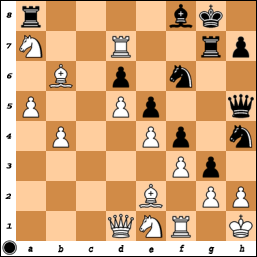
Here I will skip the details, but just give you the main line Vassilios has analysed:
25…Rg6!! 26.Bg1! Nxd7 27.Bb5 Rxa7 28.Qc2! Rb7 29.Bc6!? Rc7! 30.h3! Nxg2! 31.Qxg2 Qh6 32.Bb6 Nxb6 33.axb6 Rc8 34.b7 Rb8 35.Nd3 Rg5 36.Ra1 Rh5 37.Bd7! Rxb7 38.Be6† Kg7
Despite having played optimum moves in the last sequence, White is still struggling badly.
When I was young I took chess way too seriously. I would cry when I lost some games and I would start to doubt my whole existence. I remember one game where I was playing for an IM-norm against a player I have 11.5/13 against, including a quick draw in 1989. You guessed right – the loss was in the game where I was playing for the norm.
This lifetime score might not fully reflect the difference in level between us, but it does reflect the difference in me once I was in a demanding situation. I froze. Too much emotion, no space left for chess in my system.
I see the same happening from time to time with students, but as a lot of our action is online, I mainly see a lot of this stuff on the tennis courts. Some of the guys I play with behave well under all circumstances. Some behave appallingly. Especially when they miss a shot.
What I have noticed is that their play disintegrates from this moment. Giving yourself space to be disappointed might be good, but the shouting and shooting balls in the fence and so on, is not only a pain to people around you, it makes you more likely to lose the next shot.
Read more…
Ankit Rajpara, a young Indian grandmaster, won surprisingly against Arkadij Naiditsch in the first round of the big open in Qatar.
Early in the opening he came up with a funny manoeuvre in order to open the h-file. Later on he sacrificed a piece in order to penetrate in the self-same h-file and win the game.
Naiditsch (2719) – Rajpara (2494)
Doha 26.11.2014
1.e4 c6 2.d4 d5 3.e5 Bf5 4.Nf3 e6 5.Be2 Ne7 6.0–0 Bg6 7.Nbd2 Nf5 8.c4 Be7 9.g4
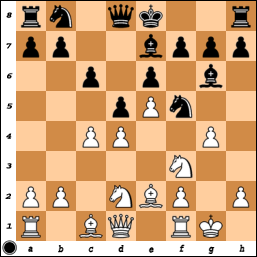
9…Nh6 10.h3 Ng8 11.Ne1 h5 12.Ng2 hxg4 13.hxg4 dxc4 14.Nxc4 Be4 15.f3 Bd5 16.Nce3 c5 17.Nf4 Bc6 18.d5 exd5 19.Nfxd5 Bh4 20.Kg2 Bg3!?

Read more…
This week I just wanted to give a little reminder to those who might be maximalists and not wanting to give up material in order to convert an advantage. I know it is a quick and boring blog post, but then the other guys have promised to put a few things up as well.
Filippov – Saric, Croatian League 2014
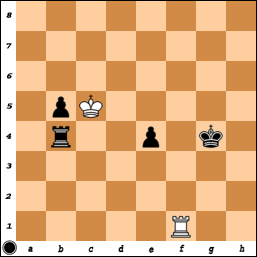
Black to play and win
Read more…
Not surprisingly Magnus Carlsen defended his World Championship title. Apparently he was ill during a good deal of the match, but it still seems that he won without truly breaking sweat.
In my opinion both players had the same problem in this match. Carlsen did not truly believe that Anand was a threat and thus struggled to keep up motivation. Anand also did not think that he was a threat and for this reason he did not present one when he had the chance. In this way the match never really got as exciting to me as it could have.
In this article I want to present three moments where Anand performed worse than he could have.
Carlsen – Anand, Sochi (2) 09.11.2014
1.e4 e5 2.Nf3 Nc6 3.Bb5 Nf6 4.d3 Bc5 5.0–0 d6 6.Re1 0–0 7.Bxc6 bxc6 8.h3 Re8 9.Nbd2 Nd7 10.Nc4 Bb6 11.a4 a5 12.Nxb6 cxb6 13.d4 Qc7
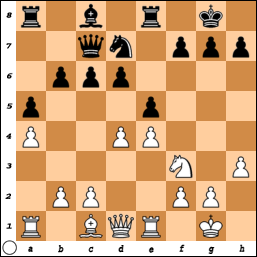
After achieving nothing from the opening Carlsen now sets up an attack on the kingside. It really should not be too difficult to deal with, but Anand loses without a fight.
14.Ra3 Nf8 15.dxe5 dxe5 16.Nh4 Rd8
I doubt whether this improves Black’s position.
17.Qh5 f6 18.Nf5
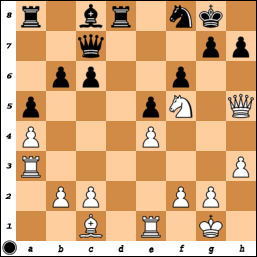
A very important moment in the game. Anand played his next move quickly and never really recovered. As it is pretty obvious what White is trying to do, it would have made sense if he had a deep think here and decided how to deal with the attack.
Read more…
When I write on this blog I try very hard to keep things professional, without making them dull. When I am on my Facebook account I will happily debate things freely, defend controversial points of view or defend dogmatic points of view for that sake, should I agree on them. (An interesting thing is that it is always with the second type of defence that you get into the really difficult discussions with people that are really passionate! It must be like that debating with me at times then!!)
Recently someone tried in private conversation to make a link between the two Worlds, somehow wanting to question the ethics of Quality Chess because of my general views of the moral stand on income tax and ethics in general (views that do not belong here!). The dig was that Quality Chess had somehow a low level of ethics because he felt that Lars Schandorff’s book on the Semi-Slav is being “ghost written”.
This leads to obvious inspiration regarding who writes what on a few projects.
Let us start with Playing the French. It is no secret and has never been a secret that this book is to a great extent written by Nikos, with me advising, helping in choosing lines, finding a few novelties (the best of which was unfortunately played in a Corr. Game before the book was finished) and looking over the finished book. It says as much in the foreword. Nikos did not feel confident enough for the book to have only his name on it. It is the main reason I allowed my name to appear on it. And then the fact that the book was great and I knew it would be great and that Nikos and I work together on openings all the time (that I work on openings). If the book had not been good, I would not have wanted myself associated with the book. As it was, I was centrally involved, just not as the main writer, and I did go over the rest of the book. And we were always very open on this structure of the work with everyone. In the foreword and on the blog.
The book was 2nd in the Chess Publishing Opening Book of the Year Vote.
The winner was another group project. John Shaw’s The King’s Gambit, the ultimate murder weapon (at least if you hit someone with the hardback version). John wrote at least 60% of the book. I wrote maybe 10% and Andrew maybe 25%+. John checked everything over and made sure he was happy with it. Had John been alone on this project the book would never have existed? Now it is a best seller.
Again, we were open about this.
Read more…
Recent Comments