Gelfand Cover Considerations
September 26th, 2014
70 comments
Should we go for Cover A
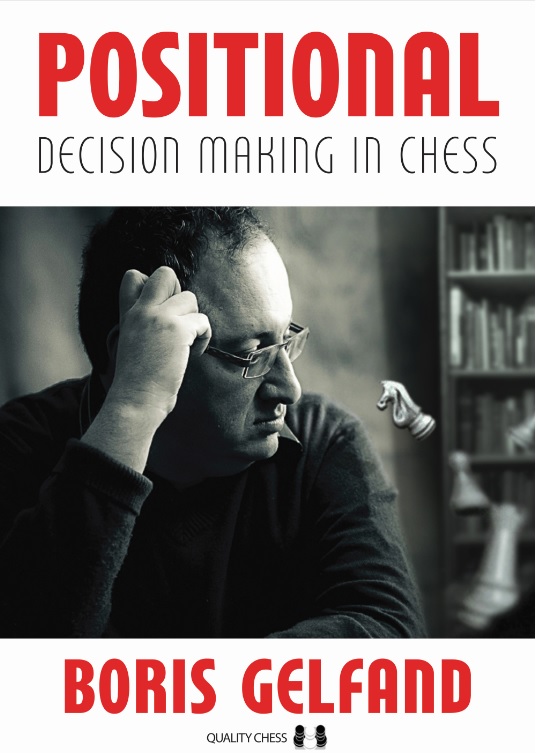 or Cover B?
Categories: Publishing Schedule
Should we go for Cover A
or Cover B?
On Friday we received an email from a book reviewer congratulating us on the outcome of the referendum, where the Scottish people declined the proposed secession from the United Kingdom. I answered him, stating that we were actually divided in the office on the best way forward, with one declared supported, two clear no-votes, one “evil referendum” opinion and two undeclared.
We start with a preview from the Gelfand book, taken from a variation from Navara – Gelfand, Prague (1) 2006.
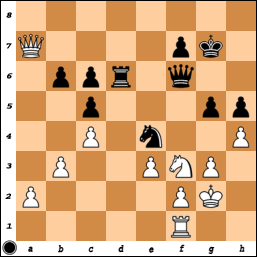
Black to Play and Win
In our weekly editorial meeting we have been debating the book with the working title Chess from Scratch at length almost every week. To cut to the pawn ending, basically we have wanted to squeeze a Soviet treasure into a title where it did not fully fit.
The title is not a description of the content of the book, but something we use to make people look at the book and find it interesting. Once you have people reading, hopefully they will forgive you anything. Obviously we care a lot about what is inside the book and not about the title, though we have to find good titles nonetheless…
On Friday I came to the meeting with a bombshell. I had finally realised that the box did not fit. We want to develop the ‘From Scratch’ series with a few more books, based among others on how much we love Chess Tactics from Scratch. But the Maizelis book does not fit. No matter how much we wanted it to fit.
So, we will publish it as The Soviet Chess Primer. It will be out in 5-6 weeks. We will have another book called Chess from Scratch quite soon as well. The author is someone a lot closer to home. Me.
The position at the start of the article Read more…
In Endgame Play I think I had a few interesting insights, besides a lot of training material, in an already well-explored part of the game. I think the most interesting chapter in the book was probably the chapter on Fortresses. I have after I wrote the book been made aware of some interesting articles written on fortresses, but in general it is a part of chess that has not been explored fully. For example, Dvoretsky’s Endgame Manual is not very strong in this area, despite being sensational (and essential) in many others.
In Endgame Play I came with a few thoughts about fortresses that I personally find interesting to explore further. I am not sure I will do it personally, nor that they are accurate. But I found them useful in understanding the positions I had collected for the book.
The first thought is to see fortresses not as something that holds or not, but as a defensive technique. For the practical player this makes most sense anyway.
The second is to see how fortresses usually fail. Of course there can be a break that makes the fortress collapse, but in general what I found was that zugzwang was a big part of the picture. Surprisingly a lot of fortresses fail to exactly this position.
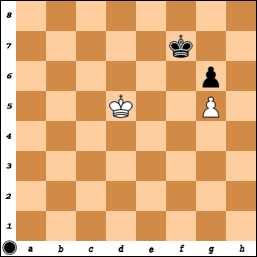
White has just played Kd5 and Black loses due to zugzwang. Previously White has probably exchanged a piece on f7. Obviously you could add h-pawns without ruining anything. But once the pawn is back on g3, things are a bit more difficult as we shall see.
The third observation is one I will just leave hanging in the air, but which you will see the value of if you look at the book. It is the only of these that can be said to have a real novelty appeal to it. The idea is that most bishop endings are defended through the fortress technique. As said, I will just hang it out there for you to ponder. My observations say that it is so.
On my way to winning the Largs congress this past weekend, I twice faced the Chigorin Defence against the Queen’s Gambit. I haven’t faced this too often, but I could remember the basics of Avrukh’s repertoire in Grandmaster Repertoire 1.
1.d4 d5 2.c4 Nc6 3.Nc3 dxc4
In the first round my opponent played rather passively with: 3…Nf6 4.Nf3 e6?! (4…dxc4 transposes to Greet – Wynarczyk) 5.Bg5 Be7 6.e3 White has a comfortable version of a QGD, as the knight on c6 is misplaced. 6…h6 7.Bf4!? (7.Bh4) 7…Bd6 8.c5N This logical move is a novelty, although it soon transposes to another game. (8.Bxd6 Qxd6 9.c5 Qe7 10.Bb5 Bd7 didn’t seem too bad for Black.) 8…Bxf4 9.exf4 The doubled pawns are not weak, and the f4-pawn helps to clamp down on the centre. 9…Ne4 10.Qc2 f5? A positional blunder. (10…Nxc3 11.Qxc3 leaves White with a pleasant space advantage and the better bishop, but Black is solid.) 11.Bb5 Bd7 12.Bxc6 Bxc6 13.Ne5
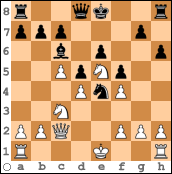
White is already strategically winning. 13…0–0 14.f3 Nxc3 (14…Qh4+? 15.g3 Nxg3 16.Qf2+–; 14…Nf6 15.b4 White dominates the entire board.) 15.Qxc3 Be8 16.0–0 g5 17.Qd2 Kh7 18.Kf2 Rg8 19.g3 gxf4 20.Qxf4 Qg5 21.Qxg5 hxg5 22.h4 g4 23.fxg4 fxg4 24.Ke3 Bg6 25.Nxg4 Kg7 26.Ne5 Raf8 27.g4 b6 28.c6 a5 29.Nd7 Rxf1 30.Rxf1 Be8 31.Ne5 b5 32.h5 Kh7 33.Rf6 1–0 Greet – Parks, Largs 2014.
4.Nf3 Nf6 5.Bg5
Avrukh’s recommendation. White makes a useful developing move before taking action in the centre.
After the game my opponent said he knew what to do against 5.d5 and 5.e4, but that he had not encountered the bishop move.
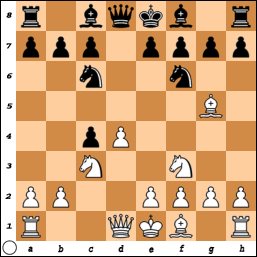
5…Bg4?!
Black immediately goes wrong, but it is easily done, as this is a standard move in the Chigorin.
5…h6 6.Bh4 (Schandorff recommends 6.Bxf6) 6…a6 is the main line, with the point that after 7.e4 Bg4 8.d5 the black knight can go to e5. I couldn’t remember much more of Avrukh’s coverage, other than the fact that White continues with Be2 and takes back on f3 with the g-pawn. I reckon this is about as much theory as you need to know, unless you are facing a real specialist.
Here is a list of some of our forthcoming books. As always, the dates are what we are aiming for and not an official publishing schedule.
| Ilya Maizelis | Chess from Scratch | October |
| Judit Polgar | A Game of Queens | October |
| Tiger Hillarp-Persson | The Modern Tiger | October |
| John Shaw | Playing 1.e4 – Caro-Kann, 1…e5 & Minor Lines | Winter |
| Boris Gelfand | Positional Decision Making in Chess | Winter |
| Mauricio Flores Rios | Chess Structures – A GM Guide | Winter |
| Mihail Marin | Learn from the Legends – Hardback | Winter |
| Boris Avrukh | GM Repertoire 1A – 1.d4 The Catalan | Winter |
| Parimarjan Negi | GM – 1.e4 vs The Sicilian I | Winter |
| Emanuel Berg | GM 16 – The French Defence Vol 3 | Winter |
| Vassilios Kotronias | KID – Vol 2 – Mar del Plata I | Winter |
| Vassilios Kotronias | KID – Vol 3 – Mar del Plata II | Winter |
| Lars Schandorff | GM 20 – Semi-Slav | Winter |
| Lubomir Ftacnik | GM 6B – The Najdorf | Winter |
| Wojciech Moranda | Race Up the Rankings | Spring |
| Tibor Karolyi | Tal’s Best Games 2 – World Champion | Spring |
| Victor Mikhalevski | GM 19 – Beating Minor Openings | Spring |
| Parimarjan Negi | GM – 1.e4 vs The Sicilian II | Spring |
| John Shaw | Playing 1.e4 – Sicilian & French | Summer |
This will hopefully be a short post, as I am rather exhausted, suffering from a cold and four hours of rook and knight vs. rook and knight endgame analysis with Boris Gelfand.
In the cause of events we talked about one of the recurring topics – what constitutes a mistake.
I wrote about this already in Excelling at Chess published back in 2001 and although I cannot remember the words I used, I do not think there was any noticeable difference between what Boris said and what I wrote back then; maybe with the exception that Boris phrased it a bit more accurately.
A mistake is a move that makes your task more difficult.
It is that simple.
The topic came up when I said at one point that I thought that one move he made was maybe not a mistake anyway, if White was able to hold the draw no matter what. I meant this in the objective sense, in which we often use ?!, ? and ??. I have to admit that in my annotations I have a strong tendency to go for ? only in the situations where the objective evaluation of the position is significantly changed. This means after analysis and engine assistance.
But this of course does not tell us anything about how many good moves we still have to find in order to win the game.
In Excelling at Chess I told the story of how a friend of mine was three pawns up and later on complained of how he missed the win when he was one pawn up. It is of course an extreme example, but this is essentially what we are talking about. It is not important if the engine can find a win, but if you can find it at the board; and how easy/difficult it is to do so.
The same with equal positions. There are equal positions that are comfortable, promising and depressing. I know which ones I prefer.
The morale of all of this is that when you analyse your games and think about your play after the game, do not complain that you are not as strong as the engines; instead understand where you needed the engines help to prove your point and where you did not. Obviously this is only relevant if you want to improve your results. Otherwise ignore and continue with your Internet blitz games!
Obviously we have some trade secrets in Quality Chess, but there are a few that are not secrets:
We print more books than we are likely to sell frequently. Starting the printer is costly; the cost of the last books printed is considerably less than the first books. Therefore it is better to overprint a bit than to print too few.
Some books are positive surprises; others are not. As you might guess, quality does not hurt, nor does it guarantee anything. Even if a book surprises positively, we end with extra books after the reprint.
Postage is getting more and more expensive. Actually, it is so expensive using the post office that it is cheaper to use UPS when the customer buys 3 books or more (over 2kg). Actually, it is the biggest expense when dealing with web orders. But UPS only charges marginally more when you add books; maybe 1€ per kg.
So, we are taking the consequences of this and will from now on be offering our EU web customers a free book on top of the free postage for orders of three books or more. And yes, should you order six books; we will of course put in two free books (and not of the same, of course).
I am not sure if we can automate this system easily; we are talking to our web designer at the moment, so that the customer is given a free choice of freebie. If not, we will probably do a “free book of the month” thing. Please be patient while we work this out.
For now, the free book of August and September is San Luis 2005, one of the best chess books of all time.
Recent Comments