Jorden van Foreest – Viswanathan Anand Tata Steel Masters, 12.01.2019
With Sam Shankland playing in the elite Tata Steel event (and currently sitting on a respectable 2/4 with four draws), we can’t help but pay attention to some of the pivotal pawn moves being made in the tournament. When you see games at this level being won and lost due to good and bad pawn play, it makes you appreciate even more what a vital topic this is. Take the following example:
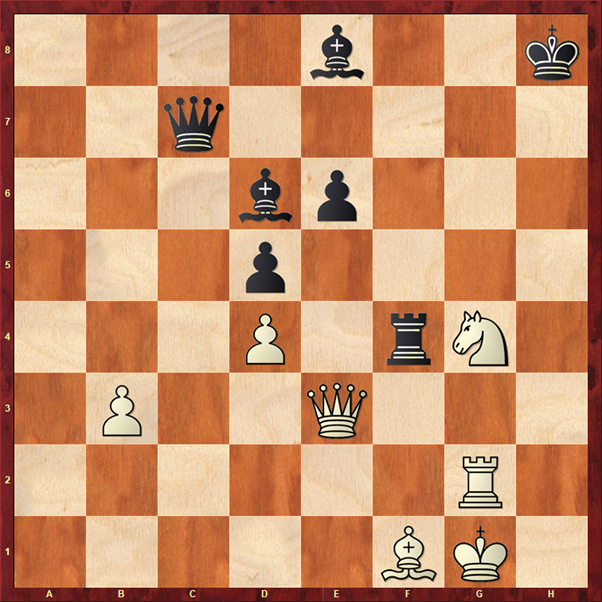
1.e4 c6 2.d4 d5 3.exd5 cxd5 4.Bd3 Nf6 5.c3 Qc7 6.h3 g6 7.Nf3 Bf5 8.Ne5 Nc6 9.Bf4 Qb6 10.Bxf5 gxf5 11.Nd3 e6 12.Nd2 Rg8 13.0–0 0–0–0 14.a4 Ne4 15.Rc1 Bd6 16.Bxd6 Nxd6 17.b4 Kb8 18.Qe2 Qc7 19.Qe3 Ne7 Black has a comfortable game but there was no need for White to self-destruct with his next move:
20.f3?? Van Foreest must have thought he could withstand the pressure along the g-file, but in reality this is much too weakening, as Anand expertly shows.
Top-level chess kicks off for the year tomorrow with the huge Tata Steel event in Wijk aan Zee in the Netherlands. There are many tournaments, with most focus on the Masters which has an elite field headed by World Champion Magnus Carlsen. Also hoping to make an impact will be US Champion Sam Shankland.
Naturally the Quality Chess connection to Sam is his book Small Steps to Giant Improvement. But if you prefer to receive Sam’s pawn-related instruction in video form, then below is a lecture Sam gave at the St Louis Chess Club.
IM Sam Collins referred me to this email, because Adhiban said some nice things about the Quality Chess Academy, but I am putting it up here because Adhiban is fantastic and the game is fantastic and if you have half an hour to watch it, you should.
The latest Quality Chess book available in the Chessable format is GM Jacob Aagaard’s Calculation. If you are interested in this book in this format then it is best to act within a week, as it is Chessable tradition to offer the course at a reduced price for the first week.
If you have bought any of our books in Chessable format then I am interested to hear what you think about it. This is only the third book we have put on Chessable (after The Woodpecker Method and Small Steps to Giant Improvement) and so far feedback seems highly favourable.
Boris participated in some of the training at the camp in November. We created a short video based on one of the examples where Boris felt the intended solution was not the ideal one.
My girlfriend gets upset with me whenever I claim to be old. She does not remember the fall of the wall at all, while I remember the Iran hostage crisis. I cry about the death/retirement of Rock ‘n Roll, while she sees it as a genre of Classical music, as I see Mozart, Gershwin or Charlie Parker. A decade ago Yusupov told me he participated in the European Championship and played eleven GMs between 2500 and 2600 of whom he had never heard at all! This was his “I am from the past” Epiphany. I have lots of them these days and honestly I enjoy them. I like the way new chess publishers are trying new things. As the old fart I am, I like what we do best of course, this is why we do it this way. But I really like that things are moving forward. Yesterday I was made aware of two videos by GM Mykhaylo Oleksiyenko, whom I honestly still thought of as 21 years old. Actually, he is 32 and has three beautiful children, as the internet informs me. But thank you for Michael to making me aware of these videos, they are very complimentary to me. The first one deals with the method of the three questions in a tactical setting, with a position I first saw in Byron Jacob’s wonderful little book Analyse to Win, but there were a small mistake, which was the justification for me including it in Excelling at Chess Calculation, with some chat.
This one is a bit harder and I have to confess that I got it wrong! But it is all very logical and instructive.
Overall this first visual encounter with Mykhaylo Oleksiyenko was been a total pleasure for me. Not so much because of the nice recommendation of the three questions, but more because of the clarity and high level of his explanations of the positions. If you are looking for a private trainer, I think he teaches on Chess.com, which apparently is not just about Puzzle Rush… You can find him on Facebook here.
And yes, The Woodpecker proved itself worthwhile. Usually we chess players praise first and by far foremost the content, but here I want to praise paper and binding as well. Very good job!
The attached picture was made 3600+ meters above sea level in the Simien-Mountains – and the book survived later on 100 meters below sea level as well without visible problems. Keep on working on good content AND on good paper/binding – both is much appreciated.”
Thanks Michael! So if anyone was wondering if you could do your Woodpeckering 3600 metres up a mountain in Ethiopia, then the answer is yes. I am sure Axel and Hans would approve.
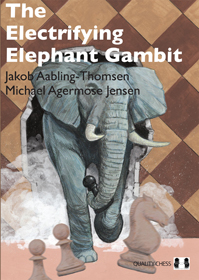
First of all, check out the fantastic cover design for this book!
We have received a number of draft chapters from our Danish friends Michael Agermose Jensen and Jakob Aabling-Thomsen, the Elephant enthusiasts – that is, 1.e4 e5 2.Nf3 d5. They are doing excellent work and I can see the finished book having a ‘Mayhem-in-the-Morra-esque’ effect, whereby people realize the gambit is much better than its reputation.
Having seen snippets of the work, I have not been able to resist experimenting with the Elephant every now and then. I tried it in two rapid games against lower-rated opponents, both of whom accepted the gambit. I went slightly astray in the opening (the relevant chapters have not been delivered yet, so I had to rely on my own guesswork rather than the authors’ expertise) but won both games after some adventures. Perhaps more significantly, I played the Elephant in two local league games against guys in the 2250-2300 range. Both of them were too fearful of the Elephant’s tusks to accept the gambit pawn, and opted for a more timid line involving an early queen exchange. In both cases I equalized quickly and pressed for an advantage, eventually eking out a win in one game and settling for a draw in the other.
Obviously I won’t be playing the Elephant in every game, but so far it has been a delight to get it on the board and force my opponents to think hard at such an early stage. What do our blog readers think? Can you see yourself adding the Elephant to your repertoire as a 6,000 kg surprise weapon?



Recent Comments