Archive

Archive for the ‘Jacob Aagaard’s training tips’ Category

Understand what type of player you are and adjust your style accordingly

June 10th, 2013 104 comments


My Danish teammate Grandmaster Sune Berg Hansen mentions Foundation of Chess Strategy by another Danish Grandmaster, Lars Bo Hansen, as the chess book that has had the greatest influence on his own chess. It is not so much the explanations or the chess in the book, but the concept of dividing players into four categories that made an impression on Sune.

Lars Bo Hansen puts a name to four types of players and debates how they should play and how to play against them. They are: Activists, Reflectors, Pragmatics and Theorists.

They are divided into a grid that looks like this:
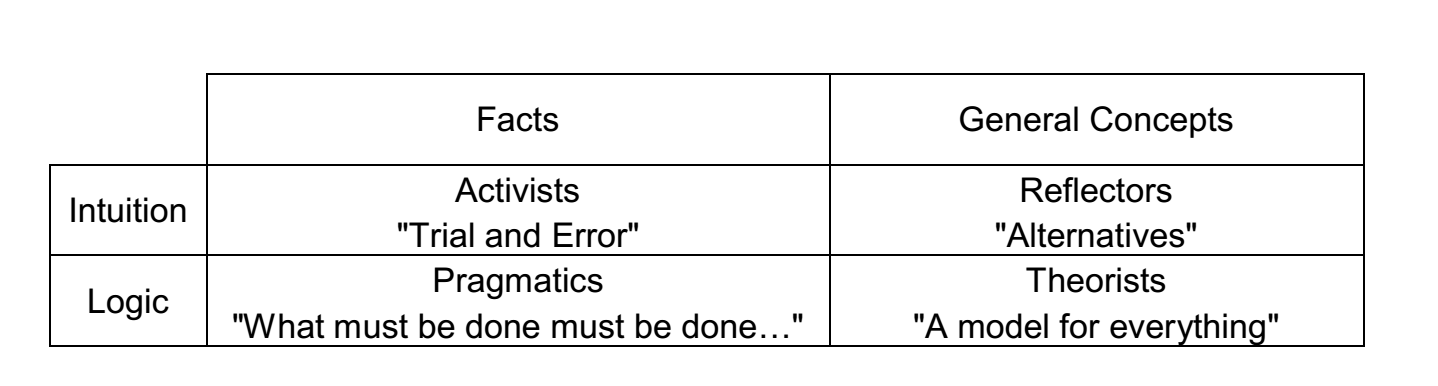
Grid

Lars Bo Hansen describes the inherent characteristics of each player, their strengths and weaknesses and so forth. While I find the chess a bit uninspired in the book, I do find the concept extremely useful and would recommend anyone to read this book and identify themselves in the grid.

The point to this is that the idea of the all-round player is close to being an illusion. Of all the World Champions the only one continuously mentioned as an all-rounder is Boris Spassky and I have a feeling that this is as much tradition as it is fact. And anyway, the ‘narrow-minded’ players who beat him up in matches, Petrosian, Karpov and Fischer all stand above him in chess history as far as I am concerned.

So, what we should do is design our opening repertoire according to our style and slowly improve in the areas where we are weak (avoiding them at all costs usually means a lot of rating points). But there are parts of chess that are better suited to our way of thinking, to our character and so on.

A final note on Hansen’s book: The references to business are poor as far as I am concerned and could with benefit be ignored entirely. Luckily they quickly disappear from the book. The idea of this particular grid does not originate in the world of business anyway; as with so many other things, it was thought up in Russia. I first saw it in Mark Dvoretsky’s writings as a brief note so it is possible the idea was his to start with.
Categories: Jacob Aagaard's training tips Tags:

How to become a World Champion

June 3rd, 2013 32 comments

During the candidates tournament in London I had dinner with my good friend Alan Minnican and not surprisingly, the conversation circled to chess improvement at some point. Alan was considering lessons, but is very busy with work. I assured him that hiring a good trainer would be worth it, but that the first thing he should do was to spend 20-30 minutes a day solving exercises.

Now, usually when you give someone advice, nothing happens. People generally do not change their habits or their way of approaching things and for this reason rarely have changed results. But of course there are exceptions. Alan turns out to be one of these:

“You can thank Jacob for his chat at the candidates and his recommendation for daily calculation/combination work. I only have two books here: Calculation and his older one Excelling at Combinational Play.” Alan Minnican, 2013 U-2200 ACO World Champion.

Besides just stating that the first advice given in this series of postings has already paid off with tournament success, I want to talk about an issue I have been thinking about recently.

You get what you pay for

Although this old adage certainly is not true regarding everything, it does seem to be true when it comes to chess training. I see a lot of kids and amateurs using free exercises from Chess.com or Chesstempo.com in their training. The attraction of having a rating for your solving and to have a system that chooses the right exercises for you is of course high. Unfortunately the quality of the exercises is generally low. So, in order to satisfy a very primal need for instant gratification (the rating part) and follow the basic business model we use (money in good, money out bad) people end up spending a lot of time dealing with very low-quality training material. And a chess book is really not that expensive!

But I would like to add that you really want to use a somewhat recent book, which has been checked with computers. Not because people played worse in the past, but because sometimes something flashy was stupid and the exercise in itself was pointless.

A good example of a book I should have stayed away from is ****** ***** ***** by ********* ******. There I found the following exercise:

Read more…

Categories: Jacob Aagaard's training tips Tags:

A question of focus

May 27th, 2013 29 comments


I was quite fascinated with the annotations to the following position in New in Chess by two Dutchmen, Anish Giri and Willy Hendriks. But before we talk about it, we can make it an exercise for those who want it to be.

Black to play and win - Carlsen

Black to play and win

The thing that fascinated me about this position (which of course is Svidler – Carlsen, London Candidates 2013) was the way the two authors talked about the missed possibility. Hendriks writes that “you may expect it to be rather trivial (the idea that is, not the resulting variations)” while Giri writes that “…but the line is not for mortals.”

Had I not been in London that day I might have written the same thing in my article for Skakbladet. It is a normal respectful thing to say; the winning idea was nothing out of the ordinary, but making it work takes a bit of effort and since the best player in the world did not play it, the lines must be really difficult.

But as so often, reality is surprising. When Carlsen was asked at the press conference if he had looked at 25…Bxh3! he said no, clearly surprised. He had a look at the position, maybe 10 seconds, and then concluded that it was “decisive”. Those difficult lines were not so difficult for him to work out. After the press conference I took a few minutes to work out that 26.dxe4 Rg5 27.g3 Bg4 28.f3 Rb2! is indeed decisive, on account of 29.Qxb2 Bxf3 and the dual threat of …Bxd1 and …Qh3.

(Update: John pointed out that Csaba Balogh wrote in the Chess Evolution newsletter that Carlsen missed 28…Rb2. The delusion is total.)

In the same article Hendriks makes some comments about Positional Play, which he has told me he has not read yet, and that the comments should be seen as a general reaction to Monokroussos’s review. But it does allow me to underline the basic point of the three questions training method (always remember that it is not meant to be used on every move at the board, though as one of many tools in your kit, it is acceptable) is that it trains your focus.

Clearly had Carlsen, for a second, thought about winning the game in an attack, he would have done so. Even when you are onboard the 2900 rocket your focus is not perfect. This teaches us that we can always improve this, and working with books like those in the Grandmaster Preparation series can aid this.

Later in his article Hendriks says that the only training method that works is looking at good chess. This is a very extreme statement and in some way I think it has helped me a bit to understand how some authors with similar views look at those of us who include general principles in our writing: as opposing extremists. I am not saying that Hendriks does this, but others clearly do in the way they write about the opposing view. Basically, what they believe is that the people who talk about “rules in chess” must view the move Nf3-e1 as a move away from the centre (although, in the case I am thinking of, it should be seen as Nf3-e1-c2-e3-d5, taking the only viable route to the centre). The problem with seeing it in the intelligent way is that it is less extreme and does not work well as an enemy. Or they might want to think that concrete lines cannot co-exist in a belief system that includes general assumptions about chess. If this is you, please read Mark Dvoretsky’s books. They are very concrete and they have lots of general assumptions.

Categories: Jacob Aagaard's training tips Tags:

Ten ways to improve in chess

May 20th, 2013 132 comments

Clearly this blog is not brilliantly planned out and not intended to give a clear course in chess improvement. It is simply about topics I have considered along the way, which for some reason are in the forefront of my mind.

But this week I am trying to write a disciplined blog entry; one that I feel I should write. It is a bit like going for a swim in the ocean, rather than lying on the beach watching the girls walk by. It is good for you and you might even enjoy it once you get going, but it is not your preferred choice.

So here come ten possible ways for you to improve your chess. No matter who you are, if you are seeking my advice on anything, you will find at least a few strategies here that will help you along the way.

1. Analyse your own games deeply (and the games of others).

2. Solve puzzles regularly (my advice is six times a week x 20-30 minutes).

3. Understand what type of player you are and adjust your style accordingly.

4. Push your levels of concentration upwards and become a fighter.

5. Play real openings. Throw away the London, c3-Sicilian or whatever rubbish you are playing. If you want to develop as a player, playing main lines is important.

6. Learn by heart all the 222 obligatory positions from Dvoretsky’s Endgame Manual.

7. Play through game collections with good comments.

This might vary from player to play; for some the Move by Move stuff from Everyman might be reasonable. But for most readers of this blog, I recommend books written either by great players, or books with a great reputation. For example, Botvinnik, Smyslov, Kasparov, Nunn, Anand, Karpov (the old books), San Luis 2005 and so on.

8. Use your body to the best effect for the game (stop poisoning it, for example).

9. Analyse your openings deeply and find your own systems with your own ideas.

10. Understand the basic principles of dynamics, statics and strategic play. These can be studied indefinitely of course, but you can always improve your understanding.

There are always a lot of ways to do anything. Anyone who wants to sell “the only way” is either selling chess studies or tablebase printouts. In the same way, it is possible to reach the same conclusion by many different thinking processes.

The only real danger here is that you fall in love with one system and become fixed to it. You can be the openings guy, or the endings guy, or the expert in solving studies. My closest-sitting colleague in the office, GM Colin McNab, is the last two. I am not sure if it has given his over-the-board play any great advantage, compared to if he had spread out his studies. On the other hand, he just regained the British Championship in solving (yes, Nunn and two other World Champions were competing)…

If you have to pick only one strategy (could be ‘Number 11’ for all I care), I would recommend to either do the one that excites you or the one you know you have been delaying forever.

Categories: Jacob Aagaard's training tips Tags:

Analysing your own games

May 14th, 2013 15 comments

Update: A clearer conclusion has been added.

There are many ways to improve in chess, and I shall list a few of them next time. But this week, I want to focus on just one area – analysing your own games (as well as those of others). The simple yet important point is that, as with everything else in life, if it is not done well, you will not feel the benefits.

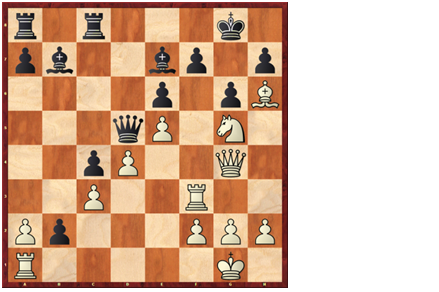
Mauro – Marina Brunello, Perugia 2011
Marina A

22…Bxg5 23.Qxg5 Qd8 24.Qf4? 24.Rf6 with a worse, but still playable, position was to be preferred. 24…Bxf3 Now Black wins. 25.gxf3 Rc6 26.Bg5 Qe8 27.Bh6 f5 28.exf6 Qf7 29.axb3 cxb3 30.Qe5 Rac8 31.Bd2 Rb6 32.Be3 b2 33.Rb1 Rb7 34.Bd2 a6 35.h4 Rb5 36.Qd6 Qxf6 37.Qxa6 Rcb8 38.Qd6 Qf5 39.Kg2 R5b6 40.Qd7 R6b7 0–1

22…b2 was better, in Marina’s opinion. She was following the computer’s line of thinking and concluded that Black was doing well after 23.Rf1 Rf8 and now either 24.Rh3 Bxg5 25.Qxg5 f6 26.Qg4 Qe4 and Black wins, or 24.Re3 Qa5 25.Bxf8 Rxf8 26.Rh3 Bxg5 27.Qxg5 f6! 28.Qe3 Qxa2 29.exf6 Bd5 30.Qh6 Rf7 and Black wins.

Checking over her analysis I asked the first question that came to mind.

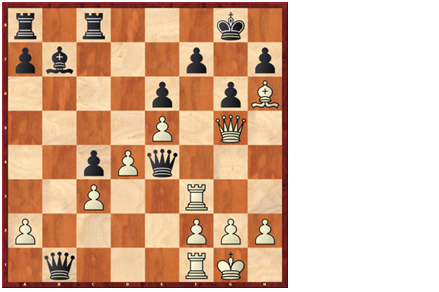
Marina B
Why should White go with the rook to f1 instead of b1, with the simple idea of taking the pawn? I put the move into the machine and immediately it went ballistic with 23.Rb1 Bxg5 24.Qxg5 Qe4, with the idea of …Qxb1 and …Qe1. But after 25.Rf1 b1=Q, things are not so simple:

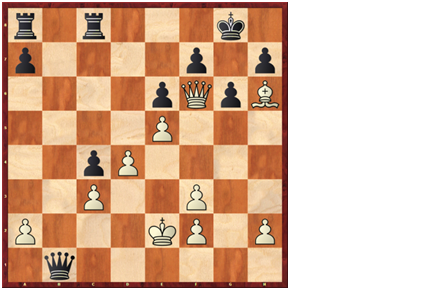
Marina C
Obviously it looks intimidating with two black queens on the board, but it does not require a lot of human brute force to find: 26.Qf6! Qxf1+ 27.Kxf1 Qb1+ 28.Ke2 Bxf3+ 29.gxf3

Marina D

I am sure the computer was suffering from a horizon problem when it first approached this position and just counted the pennies. But as our regular readers will know, quality trumps quantity every time! Black has to take a perpetual check.

Conclusion: This is not a small point about computer horizons, as it came across at first. My apologies. The idea was to be inquisitive when analysing your own games. To ask questions (and if you like using a computer, then at least make it a dialogue) and to find the answers. To remember what you were thinking during the game and find out what was right and what was wrong. It is an excellent feedback opportunity on the 4-5 hours you spent playing the game. But if you just spacebar your way through it, copying down computer evaluations, your benefit will be slim to none. Invest your mind and soul in the analysis and you will reap great rewards.

Thank you to Marina for allowing me to use this example.

Categories: Jacob Aagaard's training tips Tags:

Under the sign of uncertainty by Willy Hendriks

May 7th, 2013 24 comments


Quick comment by Jacob:

Before engaging with this debate about critical moments, I contacted Willy Hendriks and asked if he would take offence, promising to disagree, but not be disagreeable. He would not, he said. I offered if he wanted to close off the debate with his personal view. As I did not want to invite him into a quagmire of never-ending arguments, I will not comment on his piece (which I have purposefully not read yet), although I am sure that I will disagree to some extent.

In the autumn I will publish Thinking Inside the Box, which will lay out my full view of chess and chess improvement. I will probably not refer directly to other books there, but state everything in the positive. But those wanting to find it, can find my view there and then (or earlier in this debate, most likely).

Next week I will return to focusing on chess improvement in the positive. Now to our guest writer:


Under the sign of uncertainty

Willy Hendriks


In last week’s post Jacob Aagaard discusses chapter 14 of my book Move First, Think Later about the usefulness of the notion of the critical moment. I gladly accept his invitation to delve a bit deeper into this subject.

Aagaard considers this notion to be “well established” but I’m not sure it has the same meaning for everyone. Anyway, those who have read my book know that ‘well established chess theory’ is not sacred for me.

There are two aspects of this notion I’m a bit skeptical about, though they are not always explicitly brought forward. The first is the idea that games (very often) consist of a few (one or two) moments of extraordinary importance or difficulty and a lot of moments of much lesser importance.

The second is the idea that these moments not only can be identified with hindsight but also can be detected when you’re actually playing a game. Which would make the notion a constructive part of our thinking process. Read more…

Categories: Jacob Aagaard's training tips Tags:

Critical Moments

April 29th, 2013 95 comments

In Chapter 14 of his wonderful book Think First, Move Later, Willy Hendriks takes objection to the well-established idea of critical moments, with a direct reference to my book Excelling at Chess Calculation (Everyman 2004).

Obviously I am honoured to be the antagonist in a full chapter of Hendriks book, even if he does not elevate me to the level of a Bond villain. Especially because he initially represents my explanation of what a critical moment is rather truthfully.

The position I use to explain the concept and which Hendriks represents is this:

Aagaard – Ong, Sweden 2003
Aagaard-Ong

After Black’s last move, to my horror I realized that 18.e5 would be met with 18…Bb4. I understood quickly that unless I found something strong, I would be seriously worse. For that reason I struggled with the position for almost 50 minutes before I came up with the solution:

18.e5 Bb4 19.Bf5!! Bxe1? 20.exf6 Qb6 21.Be3 Rxe3 22.fxe3 Bxg3 23.Qg4 Bf2+ 24.Kh1 Qxf6 25.Bxc8 h5 26.Qd7 Bxc8 27.Qxc8+ Kh7 28.Qc2+ g6 29.Rf1 1–0

So far all is well, but then Hendriks starts to psycho-analyse (me?), claiming that it is all hindsight. Maybe there could have been no 19.Bf5 available. His argumentation is probably fairly represented by this quote: “With hindsight it’s easy to say: ‘there I went wrong, that was the critical moment, why didn’t I use some more time there?’”

Read more…

Categories: Jacob Aagaard's training tips Tags:

What is Calculation?

April 22nd, 2013 9 comments

In his generally thought provoking, deeply intelligent and beautifully human book Think First, Move Later Willy Hendriks talks about various concepts. One is calculation, another is combinational vision and a third is seeing. But when reading the book I did not get the impression that the author had a clear definition of all of those; especially calculation.

In order to have a meaningful conversation, it is good to know if you mean the same things with the words you use. We can all think of words that have two opposite meanings, with my personal favourite being the word original, which prior to around 1750 meant “as it was in ancient Greece” or something to that effect; a permanent truth. After this of course it has meant “not seen before”, which is the way we use it today.

When discussing things or explaining complex points, it is good to agree that a cat purrs rather than barks. I have often made the mistake of believing that people would understand what I meant, when I used common terminology, only to find that this was not the case. A recent example was a review where my book Positional Play apparently did not deal with dynamics. As one of my three questions is: which is the worst placed piece, I found this confusing, but rereading it today, I see that the reviewer is a bit all over the place:

Adams-Giorgadze 29.h4!

Taken from Adams-Giorgadze, Groningen 1997. The correct move is 29.h4! to put further pressure on the hook (a type of weakness) on g6. The reviewer insists that the tactical point that 29…Bxh4 is refuted by Bxg6 and Qh6 (in either order) is dynamics. Something very similar in Hendriks book is called calculation.

Let me give my own definition of some of these words (which others are by no means forced to follow!). Hopefully they will be meaningful and helpful to those reading this blog.

Dynamics: The immediate aggressive potential of the pieces. e.g. a dynamic advantage means your pieces are ready to do harm, while the opponent is uncoordinated.

Tactics: Operations based on very concrete variations.

Combinational vision: The ability to spot well-known tactical patterns.

Seeing: To me this includes something like why 29…Bxh4 does not work. It is definitely because of a tactic. But what it is not (for me) is:

Calculation: Forcing yourself to look for moves/variations either a) beyond your natural horizon or b) outside of your intuitive spectrum.

Obviously, the last two are subjective. What a GM sees, others will have to grind their way through with gritted teeth (calculation). When you work on your calculation, you will automatically improve your ability to see. You are slowly (very slowly) pushing your horizon away from you.

Sorry if this post is a bit technical, but it will all make sense when I discuss Hendriks book a bit more intimately next week, specifically Chapter 14, in case you want to read it in advance.

(A final note on the review: To make some sort of point, the reviewer puts the black king on g7 in a comparative diagram, to make a point I don’t fully understand. Obviously chess is not an entirely static game; the pieces move! But at the same time, chess is also a static game, so those armed with poor understanding and a computer will struggle to understand quite a lot.)

Categories: Jacob Aagaard's training tips Tags: