Archive

Archive for the ‘Jacob Aagaard’s training tips’ Category

The Lazy World Champion?

November 25th, 2013 94 comments

In the 60 minutes segment on Magnus Carlsen a few years ago Friedrich Friedel (the journalist behind www.chessbase.com) called Carlsen a bit lazy. Others have tried to put this label on the new World Champion, but I personally never bought it. And if you checked the recent Norwegian documentary on Carlsen, you will at one point see Henrik Carlsen rubbish the claim, stating that Carlsen has looked as much at chess as anyone else of the same age.

The new World Champion is an excellent example of a number of abilities.

First of all, more than anything, incredible determination. In Chennai Carlsen was wrapped in a bubble with no contact with anyone outside his team. Even when he was relaxing in the bowling hall, his thoughts were on the match. A journalist and photographer tried to get a photo of Carlsen somewhere else than the playing hall. Espen Agdestein, Carlsen’s manager (and brother of Simen) saw the journalists and gave them two and a half minute to take a discreet photo, but the Indian bodyguards got to them before they got even a single snap.

Secondly he has a fantastic psyche. He is not made of Teflon as some people believed before London. We should not forget that people react differently to success and to failure. Roger Federer was always the greatest gentleman in tennis – while he was winning. After he stopped winning his behaviour was more erratic and less pleasant. With Carlsen we saw him react differently to playing the Candidates than to playing in Wijk aan Zee. What is important is not that Carlsen has an emotional experience under pressure, but that he managed to keep his focus in game 13 of the Candidates.

Anand was on the other hand not in control over his reaction to the pressure of playing Carlsen. When he did not take on b2 in game three, because it would probably be a draw anyway, he did not put pressure on his opponent, and he was not able to resist the pressure when it was applied to him.

Carlsen has said that his most difficult future opponents would be Kramnik and Caruana. Personally I believe in Kramnik in the Candidates in the spring. I also believe that we will have an entirely different match next time with a challenger that fears nothing and no one. The winner of the Candidates will have these abilities; because otherwise he will not be able to win it. For this reason I believe in Kramnik more than anyone, but also think that Topalov could come through, though he is not as strong as he was at one point.

Finally, it is a pleasure for me to announce that we have been working on a little side-project called Carlsen’s Assault on the Throne. It goes to the printer in a few days and will, with luck permitting, be presented at the London Chess Classic. It will be available everywhere else on the 18th December together with From GM to Top Ten and Grandmaster Repertoire 15 – The French Defence Volume Two.
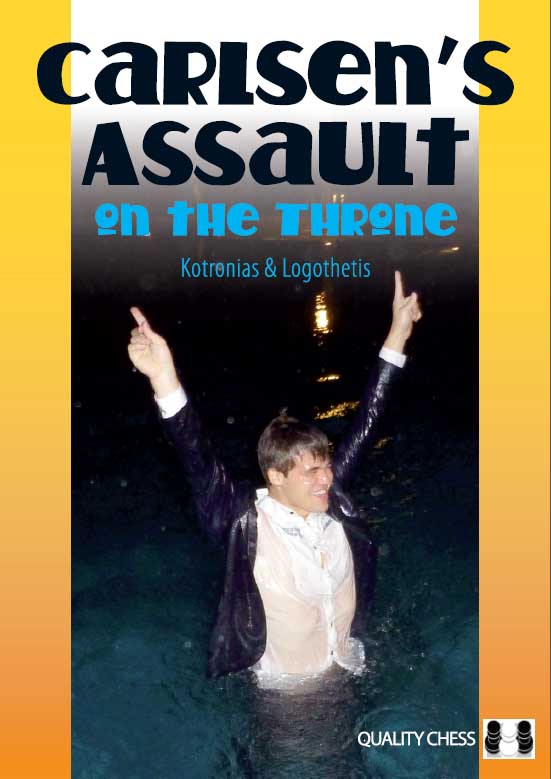
9781906552220

A few lessons from the 4NCL

November 18th, 2013 8 comments

A few months ago I wrote a post on an issue brought up by Sam Collins. I think this was an excellent chance to discuss something real. I would be very happy to answer more questions on specific areas of chess training, strategy and so on. Don’t be shy to send me games by email. Please put Jacob’s training tips in the subject matter, so I know what to expect.

This weekend we all played in the 4NCL. I am retired from serious chess, but obviously this does not prohibit me from playing chess at all. I just don’t have to care a lot about the results.

But let us dive straight into the chess. There are some basic lessons to learn from a few of the games.

The first game is annotated by John and shows a perfect example of Forcing Thinking, where you think the game will have to go in a specific direction, but it just does not.

John Shaw – Andrew McClement

1.e4 c5 2.f4 Nc6
2…d5!=
3.Nf3 d5 4.exd5 Qxd5 5.Nc3 Qd8 6.Bb5 Bd7 7.0–0 Nf6 8.Ne5 Nd4 9.Nxd7 Nxd7 10.Bc4 e6 11.b3 Be7 12.Bb2 0–0 13.Ne2 Nxe2+ 14.Qxe2 Bf6 15.Bxf6 Nxf6
Black offered a draw. It is equal, but I like to play to the death. This is partly because my strongest phase is the endgame, but I also dislike premature draws – just play the game.
16.Rae1 Qd4+ 17.Qe3 Qxe3+ 18.Rxe3
With rooks on the e- and f-files, a bishop on c4 and a pawn on f4, there can only be one threat: f4-f5!
[fen size=”small”]r4rk1/pp3ppp/4pn2/2p5/2B2P2/1P2R3/P1PP2PP/5RK1 b – – 0 18[/fen]
18…Rfd8?
As Andrew explained in the post mortem, he saw the threat, but thought: “I attack d2, White defends it, then I stop f4-f5 with …g6.” I often make the same error: treating a threat as though it is a check and cannot be ignored.

18…g6= was safe and solid.
19.f5!
My threat’s bigger than your threat.
19…Rxd2
Also unpleasant is 19…exf5 20.Re7
20.fxe6 Rxc2?
Played quickly, but a losing mistake. There is a Bobby Fischer quote that goes something like: “It’s never the first mistake you make that kills you. It’s the second mistake that happens because you were thinking about the first mistake.” 20…fxe6 would limit the damage. After 21.Bxe6+ White meets either king move with g2-g4 with a promising initiative, but the fight continues.
21.e7+-
The new e-pawn wins the game. The pressure on f7 makes the knight more of a spectator than a defender.
21…a6
21…Re8 loses to most sensible moves. For example: 22.Bb5 or 22.Rd1 or 22.Bd3 Rxa2 23.Rxf6 gxf6 24.Bb5. The only one to avoid is 22.Rxf6? Rxc4!.
22.Rxf6 gxf6 23.e8Q+ Rxe8 24.Rxe8+ Kg7 25.a4 Rb2 26.Rb8
1–0

The second topic is from my first round loss…

Read more…

Categories: Jacob Aagaard's training tips Tags:

The Counterattack

November 11th, 2013 29 comments


Once Artur Yusupov was asked why he played the Petroff and not a more aggressive opening, like for example the French. Well, he said, after 1.e4 e5 2.Nf3 Nf6 3.Nxe5 d6 4.Nf3 Nxe4 White can play 5.d3 Nf6 6.d4 and after 6…d5 we have the Exchange Variation of the French; or said in another way – White can force the Petroff on the board against the French!

Although I am personally with those looking for unbalanced positions, I do not think there is anything wrong with having a more defensive strategy as Black. Those playing the Petroff, Berlin or similar are not necessarily playing for a draw (unless they are Kramnik anno 2006 that is), but they simply have a more patient approach. The same goes for those happy to take the black side of the Exchange Slav, Exchange/Rubinstein French and everyone playing the dreadful Caro-Kann (sorry Magnus, but come on, real men only play c6 with White – as I once stated on the way to a team match [see the game below]. Naturally the guy neutralised me with the Rubinstein French in our next encounter…).

Even such formerly dynamic players, with their King’s Indians and Sicilians as Polgar and Gelfand have at times played the Petroff. Not to make draws, but to wait for the opponent to take chances.

I do not think there is a great downside to playing for a win in defensive style. It is neither better not worse than going for the initiative. As always it is the quality of the moves that matter. Obviously, if you are looking to win quickly, in order to catch a movie or the transmission of a 15 move draw from India, it is not the right strategy.

Maybe not a greatly original thought, but one I felt like sharing after the weekend.

Finally a small repetition exercise.

[fen size=”small”]2r5/2P3pp/3k4/5K2/2R4P/6P1/8/8 b – – 0 42[/fen]

Black to play and draw

The solution will be given in the comments section.

And here is the game I spoke of.

[pgn]
[Event “”]
[Site “Denmark”]
[Date “2010”]
[Round “”]
[White “Aagaard, Jacob”]
[Black ” Andreasen, Per”]
[Result “1-0″]

1.e4 g6 2.d4 Bg7 3.Nc3 d6 4.Be3 a6 5.f4 b5 6.Nf3 Bb7 7.Bd3 Nf6 8.e5 Nd5 9.Nxd5 Bxd5 10.Qe2 Nd7 11.0–0 c5 12.dxc5 dxe5 13.c4 Bxc4 14.Bxc4 bxc4 15.Qxc4 exf4 16.Bxf4 0–0 17.Rad1 Bxb2

[fen size=”small”]r2q1rk1/3npp1p/p5p1/2P5/2Q2B2/5N2/Pb4PP/3R1RK1 w – – 0 18[/fen]

18.c6 Qb6+ 19.Kh1 Nf6 20.Rb1 1–0 [/pgn]

Categories: Jacob Aagaard's training tips Tags:

Mixed Sheet of the Month

November 4th, 2013 20 comments

We have started a tradition; the first Monday of the month I will put up six exercises of reasonable difficulty (for difficult stuff – see my collected works :-)). The exercises are meant to get progressively more difficult, but as always, what is difficult for some, might be easy for others.

Spend 60 minutes maximum for the sheet. If you are a strong player, you will probably have a lot of time to spend on the last exercise; but since a 2700 player missed the right continuation, you are likely to need the time when you get there!

Write down your main line. Consider writing down a move to be the same as it would be in an old correspondence game: writing it means playing it! Thus you cannot have two moves, as some of my students have from time to time.

Points are awarded for the key ideas/moves that need to be anticipated. You are awarded the point ONLY if you have written down the move. The maximum you can score is 20 points.

Please confess to your rating and your score for others to compare with.

If you want to download the sheet, you can do so here.

If you want to download the exercises as a cbv-file with questions per move, you can do so here.

The solutions can be found here.


Categories: Jacob Aagaard's training tips Tags:

A few thoughts on time management

October 28th, 2013 68 comments


We are in the final process of editing From GM to Top Ten, covering Judit Polgar’s progress in the 1990s, with the same emphasis on chess development as Volume 1. And one of the things we have paid special attention to is Judit’s habit of including time management in her annotations. In short, whenever the position is strategic, she seems to slow down, while when it gets sharp and tactical, she often plays her move in a minute or less. This has inspired us to come up with a few ideas about time management – or clock handling if you like. They are sort of random, but hopefully not entirely useless. As always, they are not absolutes, but ideas and strategies that might resonate with the recurring problems you face in your games.


• Chess is about making difficult decisions in insufficient time. Those looking for certainty early on will burn through their time. The only certainty they will be allotted is time trouble and poor results.

• Very rarely should you play your move immediately. A quick blunder check and/or candidate move sweep helps often enough to be worth it.

• On the other hand, hesitation is a sin. When you have made up your mind concerning what you want to play, you should execute your move. You will need the time later on.

• Sometimes big decisions appear early in the game. You should not be afraid to invest a lot of time early on. There is little joy in playing a lost position with a lot of time on the clock.

• The first move after leaving opening theory is often a big trap. We need to slow down. The same goes for move 41.

• Some kinds of decision need to be worked out, others you have to guess. In general I prefer to spend my time on the decisions that can be worked out and not guess there. At least this is in theory. If I also did this consistently in practice, I would have been a much stronger player.

• I learned to write down my time right from my first tournament. It was only when I decided a year or so back that I was not trying to improve anymore, that I stopped. Especially for those with time trouble tendencies, this can be very useful. It is hard to improve on something you have not measured.

• Do not rely on the opponent’s scoresheet. In the Copenhagen Open, Arthur Kogan looked across the board and saw that Viktor Korchnoi had written down a move 41 and relaxed. When the arbiter came and asked Arthur to fill in the missing moves, Korchnoi said: “Ah well, you know, I am an old man. Maybe we should check the moves? Maybe it is not 40?” Only then did Arthur notice that Korchnoi had written down his 40th move again. (This is of course also useful for those looking for dirty tricks.)

• Often when the opponent is in time trouble and we have a lot of time, we can get nervous and play too fast. A friend of mine had a winning position against a player with only seconds left on the clock, while he had lots of time. Missing mate in one however turned the tables…

• On the other hand, if the opponent has spent all his time, maybe we should do the same so that we can both be in time trouble. If things are not going your way, maybe inserting a bit of anarchy is a useful thing. I once played a game that went on to move 52(!) before a flag fell. Another time I played the following mad game:


Aagaard – Danielsen, Copenhagen 1997


1.e4 c6 2.d4 d5 3.exd5 cxd5 4.c4 Nf6 5.Nc3 e6 6.Nf3 Be7 7.cxd5 Nxd5 8.Bc4 O-O 9.O-O b6 10.Re1 Bb7 11.Ne5 Nxc3 12.bxc3 Nd7 13.Nxf7 Rxf7 14.Bxe6 Nf8 15.Bxf7+ Kxf7 16.c4 Rc8 17.Qd3 Bf6 18.Ba3 Ng6 19.Qf5 Kg8 20.g3 Nf8 21.Rad1 Qd7 22.Qd3 Ng6 23.Qe2 h6 24.d5 Ba6 25.Rc1 Ne5 26.Bb2 Rxc4 27.Rcd1 Ra4 28.Qh5 g6 29.Qxh6 Bg5

[fen size=”small”]6k1/p2q4/bp4pQ/3Pn1b1/r7/6P1/PB3P1P/3RR1K1 w – – 0 30[/fen]

Around here, things looked bad, but Henrik only had a minute left. I allowed my clock to run down to five minutes left and organised a counter-attack. As Henrik must have expected me to resign, he seemed to have lost his concentration. It goes without saying that neither player performed expertly in what follows, but from being a queen down, I was quite pleased to get away with it…

30.Rxe5 Bxh6 31.Re6 Rxa2 32.Bc3 Be2 33.Rd4 Bf3 34.Rxg6+ Kh7 35.Rf6 Bxd5 36.Rh4 Be4 37.Rhxh6+ Kg8 38.Rh8+ Kxh8 39.Rd6+ Kg8 40.Rxd7 Rc2 41.Bd2 a5 42. f4 a4 43.Kf2 a3 44.Ke3 Bf5 45.Ra7 Ra2 46.Bb4 Rxh2 47.Bxa3 1/2-1/2


There is definitely more that could be said about clock handling, time trouble and so on, but let’s call this a post for now.

[pgn]

[Event “Denmark”]

[Site “Copenhagen”]

[Date “1997”]

[Round “”]

[White “Aagaard, Jacob”]

[Black “Danielsen, Henrik”]

[Result “1/2-1/2”]


1.e4 c6 2.d4 d5 3.exd5 cxd5 4.c4 Nf6 5.Nc3 e6 6.Nf3 Be7 7.cxd5 Nxd5 8.Bc4 O-O 9.O-O b6 10.Re1 Bb7 11.Ne5 Nxc3 12.bxc3 Nd7 13.Nxf7 Rxf7 14.Bxe6 Nf8 15.Bxf7+ Kxf7 16.c4 Rc8 17.Qd3 Bf6 18.Ba3 Ng6 19.Qf5 Kg8 20.g3 Nf8 21.Rad1 Qd7 22.Qd3 Ng6 23.Qe2 h6 24.d5 Ba6 25.Rc1 Ne5 26.Bb2 Rxc4 27.Rcd1 Ra4 28.Qh5 g6 29.Qxh6 Bg5 30.Rxe5 Bxh6 31.Re6 Rxa2 32.Bc3 Be2 33.Rd4 Bf3 34.Rxg6+ Kh7 35.Rf6 Bxd5 36.Rh4 Be4 37.Rhxh6+ Kg8 38.Rh8+ Kxh8 39.Rd6+ Kg8 40.Rxd7 Rc2 41.Bd2 a5 42. f4 a4 43.Kf2 a3 44.Ke3 Bf5 45.Ra7 Ra2 46.Bb4 Rxh2 47.Bxa3 1/2-1/2 [/pgn]

Categories: Jacob Aagaard's training tips Tags:

Strategic Play – An interesting perspective

October 25th, 2013 12 comments

Nikos made me aware that there was a double training session from the St Luis chess club available on youtube, which would no doubt be of interest, as it presents Strategic Play in a nice way. For those at all interested in my book, I can warmly recommend it.

There was one curious thing. At the end of the first video (find the second video in the side, or click here), where he gives this position from Chapter 2.

Nguyen Ngoc Truong Son – John Paul Gomez, Ho Chi Min City 2011

1. d4 d5 2. c4 c6 3. Nf3 Nf6 4. e3 Bg4 5. h3 Bxf3 6. Qxf3 e6 7. Nc3 Nbd7 8. Bd3 Bd6 9. O-O O-O 10. e4 dxc4 11. Bxc4 e5 12. d5 Nb6 13. Bb3 cxd5 14. exd5 h6 15.Be3 a6 16. Rac1 Nbd7 17. Bc2 Qe7 18. Rfd1 Rae8 19. Qg3 Nh5 20. Qf3 Nhf6 21. h4 b5 22. Qh3 Nc5

[fen size=”small”]4rrk1/4qpp1/p2b1n1p/1pnPp3/7P/2N1B2Q/PPB2PP1/2RR2K1 w – – 0 23[/fen]

At this point he only gives the option played in the game, which is not too hard to see and quite interesting. It is in the last few minutes of the video. I will leave the end of the game in the comments and provide the correct move on Monday (or you can find it in the book on page 133). There is nothing too complicated going on here, but it is by no means easy either!

Strategic Patterns, Rules and Straw Men

October 21st, 2013 81 comments

 
An old anecdote describes a game in a German club championship. The man playing White is ambitious and proud, but not very strong; he is thinking hard, stressed by the growing number of spectators. After some sweating he plays Re1-a1. The crowd is at first stunned and silent, then one guy cannot contain his laughter any longer and soon the entire crowd is out of control.
 
The game is soon agreed a draw and the white player rushes out of the club, embarrassed and confused. At home he writes a letter to the Dr Siegbert Tarrasch, the chess columnist whose writing the man studies judiciously. He gives the position and asks if he had misunderstood something, or if the rook is not supposed to be placed behind the passed pawn.
 
A few days pass before the reply from Dr Tarrasch arrives. “Dear Sir, Thank you for reading my column. Indeed you have understood my advice correctly and you shall do well to follow it in the future. However, in this very position, Re8 mate appears to be stronger than the move you played.”
 
I saw something parallel in my childhood in my own chess club. Board One on the second team came to the board, sat down, looked bemused at his opponent and played Bxh7+. After the opponent took the bishop, our player went into a half hour think, only to realise that he was now a bishop down for nothing.
 
When I turned 40, Sune Berg Hansen wrote a very nice article about me in Politiken, which can be found on this blog as well. I was asked a few questions in advance and asked to supply a picture, as what they had was rather dubious. It was only a few weeks later that I realised that local papers all over Denmark had an article about me as well. It was incorrectly published the day before my birthday (thus on Rebecca’s birthday) and ended with the stunning quote: “Aagaard describes the way to good chess as preparation, pattern recognition and strong calculation.” Not exactly my words. Actually, I once got in trouble for criticising this point of view, but let’s not go there!
 
Rather, let’s talk for a moment about rules such as “put the rook behind the passed pawn”. We have had a number of books saying that such phrases or observations are useless over the last two decades. I remember one book that said that chess was now proven to be all tactics after Adams lost to Hydra. He probably forgot the part about fine-tuning your brain to calculate 2 million positions a second in the comparison, but let’s not get hung up on the details.
 
Those criticising the use of rules in chess education point to an understanding similar to the one in the first anecdote above. A simple word is unintelligent. And this is indeed what you are if you blindly replace your own understanding with someone else’s. But this is surely not what the greatest players of the early 20th century intended. And it is certainly not the way Mark Dvoretsky intends it – and his books are full of rules.
 
Over the last few years I have refined my understanding of this area a little bit. I think the word “rule” is the main perpetrator here and not just those inventing straw men to criticise (I love the way Dvoretsky and examples from his books have at times been used to argue against rules, while the original text is full of them). The word “rules” gives the wrong associations. Therefore I have started calling them “Strategic Patterns” instead.
 
Take Hendriks’ Move First, Think Later, where he shoots at Jeremy Silman for saying that one of the finest rules we have in chess is that an attack on the flank is well met with a push in the centre. He then moves on to analyse a number of randomly-selected games where White plays g2-g4. In less than half of these examples it makes sense to strike in the centre. Hendriks states that the rule is thus more or less worthless, because it does not even give you a 50% success rate (one objection is that presumably White also knows the rule, so only played g2-g4 because he thought a good central break in reply was not possible). He then continues to say that therefore rules in general are worth very little, which makes sense if you accept this as the finest rule (there is a small problem with accepting blindly half of the claim, while refuting the other half, but let’s leave that for the pub).
 
Hendriks and people who think like him are into patterns. A big part of chess is recognition, he says. And of course he is right. But everything has its limitations.
 
But let us take a characteristic tactical pattern. The Greek Gift sacrifice. Bxh7+, Ng5+ and Qh5. Let us say that we find all the positions where this is possible in our database (less easy than to look for all games with 18.g4). Do you for a second think you will hit more than a 5% success rate?
 
Unfair? Am I being unfair? I’m sorry? I cannot have rules and use them intelligently, while you can have patterns and a fully functioning brain?
 
I am sure you have all noticed my point by now, so I will cut to the chase. The word “rule” makes people believe it is rigid, while the word “pattern” makes people believe that we can pick and choose. That is why I no longer talk about rules, but talk about recurring “strategic patterns”. And yes, I will take my 25% with strikes in the centre against your 0.15% success rate with the Greek Gift any day. But preferably I will have both.
 
What can I learn from this?
 
I mainly teach players of international level, plus children who have to learn to checkmate with queen vs. king. I use “rules” with the GMs and explain the geometry and mechanics of chess for the kids. Players under 1800 should not think about rules, it clouds their thinking for some reason. Go to a tournament with under 1500s and listen to the post mortems. Random strategic ideas are floated all the time and seen as convincing arguments for a move’s validity. I think this is the real inspiration for Hendriks and he-my-lawyer-says-must-not-be-named. They are fed up having to ask these people to shut up and show their moves (of course they would do so politely, as they are nice people). Because in the end, chess is all about the moves. But when you have Dvoretsky, Marin or others, you will see that the strategic understanding and the analytical work are not seen as opposites, but two different tools.
 
The most important point is that patterns are to a great extent non-verbal, both those that are visual and sequential and those that are abstract (the strategic patterns). You can explain them verbally, but you cannot evaluate them verbally – and simply recognising them is not an evaluation! In the end it is just patterns you can recognise. If they offer you prospects or not is quite another matter. Knowing them gives you options, you still have to evaluate if this is an option that improves your position or not. If we take the very limited research to heart, no matter the pattern, there is less than a 50% chance that it will be useful for you on this move. But the more patterns you know, the more you can pick and choose the one that is right for this situation.
 
If you recognise yourself as a less than 2000 rated player who uses rules a lot in your games; please focus on the tactics. The reason you are under 2000 and those kids keep on speeding past you, despite all of your knowledge, is because the basic mechanics of chess are still a mystery to you. You cannot start with the abstract. A theory of the world needs a physical foundation to be evaluated in.

Categories: Jacob Aagaard's training tips Tags:

Stepping Stones

October 15th, 2013 23 comments


On holiday, so only had the chance to put up a post today.
 
One of the best ideas I ever came across in chess literature was Jonathan Tisdall’s idea of Stepping Stones presented in his only chess book, Improve Your Chess Now! Like most other great ideas in chess literature, it is a verbalisation of something strong players were already doing. But rather than being something that you can just come across while training/playing and start using some of the time randomly, putting it on the page makes it something simple and concrete that you can train.
 
The basic idea is that you find out which positions you need to pay extra attention to in your calculation, and fix the position in your head so that you can approach it in the same way you approach the initial position.
 
Last night I gave a pro bono lecture in Copenhagen with all income going to a local chess club. We discussed candidate moves a lot and the way that compounding of candidate moves is a great part of calculation.
 
Take for example the decisive moment in Kramnik – Aronian in the Candidates tournament in London. Kramnik thought for a long time before taking on d5 with the queen, trying to squeeze an advantage out of the endgame (unsuccessfully).

[fen size=”small”]r1rn2k1/4bppp/1p6/q2pPp2/1p1P4/1P2BQP1/6BP/2R2RK1 w – – 0 24[/fen]


It was quickly established with computers that Kramnik could have won with a strong punch on the light squares: 24.Rxc8 Rxc8 25.Qxf5 Rc7 26.e6! Black would have no way to deal with this other than 26…fxe6, when White plays 27.Qh5! with ideas such as 27…g6 28.Qe5! hitting the rook and preparing Bh6, winning. For example 28…Rd7 29.Bh6 Bd6 30.Qxd6! and Black is mated.
 
I am sure that Kramnik saw all of this rather quickly. But why then did he not play this and win the game? Was he afraid of risks? We know from looking at his other games, that this strange attempt of pocket psychology is nonsense. There might be some preference for technical advantages, but not so much that he does not calculate attacking lines.
 
It took me some time to work out what it was Kramnik had missed, and I had the chance to test it with a 2600 student, who knew the position, knew that White was winning, but could not refute one move, the move I suspected was difficult to refute, 27…Qb5!.
 
This is where the technique of stepping stones can be useful. If Kramnik had put this position in his mind and taken the time to do candidate moves in it, he would have won the game:
 
[fen size=”small”]3n2k1/2r1b1pp/1p2p3/1q1p3Q/1p1P4/1P2B1P1/6BP/5RK1 w – – 0 28[/fen]

 
When I put this position on the board at the lecture, it only took seconds before a few people found the winning move. Still, very strong players have failed to find this win – one of them even knowing that there was a win!

 
I will put the solution in the comments later. The main point has been made. Train stepping stones and increase your level of calculation greatly.

Categories: Jacob Aagaard's training tips Tags: